

Managed for Nature Areas
The parish council has two plots of land that are ‘managed for nature’, that is to say that they are managed with the intention of providing diverse habitats in which a different range of plants and insects can thrive. The plots are the green area around The Bear and Ragged Staff and the green area alongside Fieldgate Lane.
| The Bear and Ragged Staff | Fieldgate Lane | |
|---|---|---|
| Goals for 2026/7 | To further develop the biodiversity on the site while maintaining an appropriate level of accessibility, visibility and tidiness | To remodel the site to provide a greater level of biodiversity and improve accessibility, visibility and tidiness |
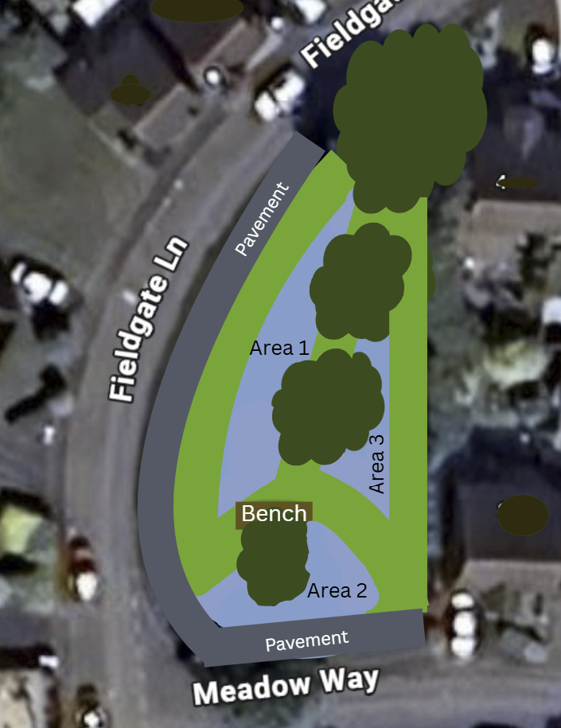
| How will this be achieved? | * Regular monitoring and management of invasive weeds to allow species that support biodiversity to flourish * Regular mowing of the border strip to support visibility and accessibility * Planting of spring bulbs in the autumn to enhance the aesthetic appeal for residents and provide a food source for early pollinators * Provision of a notice board to raise awareness of the work being done and the benefits | Implement distinct management plans for three separate areas on the site (see map below): * Area 1 closest to Fieldgate Lane will be kept shorter to support lower-level wildflowers such as clover, daisy and buttercup * Areas 2 and 3 will be reduced in size and actively managed to remove invasive weeds and to allow species that support biodiversity to flourish * Regular mowing of the border strips around the site and between the areas to support visibility and accessibility * Provision of a notice board to raise awareness of the work being done and the benefits |
Map of the Fieldgate Lane plot to illustrate the different management areas:
| Latest Update – September 2026 | The Bear and Ragged Staff | Fieldgate Lane |
|---|---|---|
| What have we done? | The area has now been mown for the winter. | The area has now been mown for the winter. |
| What have we seen? | Most of the plant species had set seed having completed their flowering season. We were pleased to discover viper’s-bugloss flowering at the end of the summer, an extremely valuable species for bees, butterflies and moths. | Most of the plant species had set seed having completed their flowering season. |
| What will happen next? | Remaining clippings will be raked off so as not to increase soil fertility. Yellow rattle seed will be spread to parasitise more of the grass. Wildflower plants will be planted in October. | Yellow rattle seed will be spread to parasitise more of the grass. Wildflower plants will be planted in October. |
| What should you expect to see over the next few weeks or months? | There will be very little change over the next couple of months. | There will be very little change over the next couple of months. |